

Manufacturers today must reduce energy use and carbon footprint while ensuring precision and efficiency. Sustainability is embedded in regulations, making eco-friendly solutions both an operational and strategic necessity.
Yet, one critical gap remains: quantifiable, data-driven proof of impact.
At Advanced Solutions, we are pioneering a new approach that brings real-time visibility, data intelligence, and digital benchmarking to sustainable manufacturing. Our solution is already helping manufacturers make fact-based decisions about energy efficiency, material optimisation, and carbon footprint reduction.
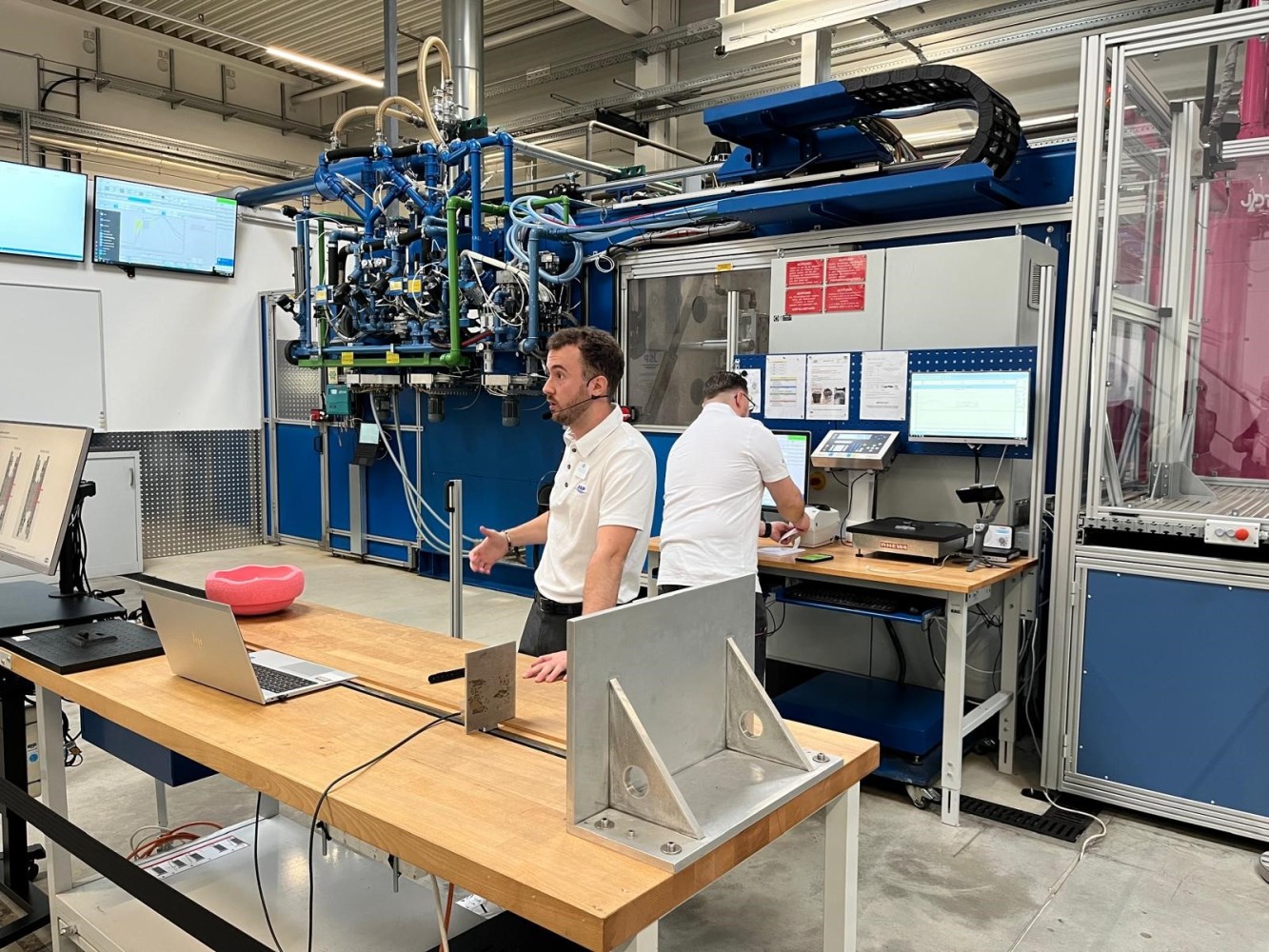
One of our most recently completed projects so far has been in JSP Innovation Centre – a leading industrial laboratory conducting benchmark studies on next-generation sustainable tooling technologies. Their goal: compare traditional production processes with new, sustainable alternatives to assess performance in energy use, emissions, cost and product quality.
This case is not just about data collection. It’s about setting the foundation for data-driven decision-making that will transform how manufacturers adopt sustainable innovation at scale.
Manufacturing is under increasing pressure to decarbonize, but transitioning to sustainable production methods comes with high risks and uncertainties:
- Will new technologies truly reduce energy consumption?
- Will process changes affect product quality?
- Can sustainability efforts be quantified with verifiable data?
The laboratory’s research and industrialisation team needed more than traditional measurement tools—they needed a real-time, data-driven framework to collect, analyse, and correlate critical production parameters. Specifically, they required a solution that could:
- Capture high-frequency processing data (temperature, pressure, cycle time, energy input)
- Analyse material properties (weight, density, fusion, tensile strength, elongation)
- Correlate process conditions with energy efficiency and emissions output
- Generate structured, fact-based benchmark reports
These requirements meant integrating fragmented systems, unifying diverse data streams, and ensuring precision-level accuracy. And, crucially, the system had to be scalable—so the methodology developed in the lab could eventually be applied in real-world series production environments.
This is where DDE Connect and DDE Analytics came into play.
We deployed two critical components—DDE Connect and DDE Analytics—to bring structure, connectivity, and advanced analytics to the laboratory’s benchmarking process.
DDE Connect: A Smart Data Backbone for Manufacturing Intelligence
DDE Connect is an advanced connectivity, data acquisition, and engineering platform designed to unify and structure fragmented production data.
Key Capabilities:
1. Seamless Connectivity Across Industrial Systems
2. High-Fidelity Data Acquisition
3. Secure and Resilient Data Exchange
4. Data Engineering for AI Readiness
DDE Analytics: Transforming Raw Data into Actionable Insights
While DDE Connect handled data capture and structuring, DDE Analytics focused on process visualization, diagnostics, optimization, and sustainability assessment.
Key Capabilities:
1. Process Visualization & Correlation Mapping
2. Dynamic Carbon Footprint & Performance Benchmarking
3. Confidential, Role-Based Data Access
The Impact: From Laboratory Insights to Scalable Industrial Adoption
This project has pioneered a new approach to sustainable manufacturing intelligence. By integrating real-time data connectivity, structured analytics, and digital benchmarking, the laboratory has created a repeatable, scalable model for assessing sustainable production methods which can lead to 30% of utilities cost reduction and up to 40% of energy consumption reduction.
Key Outcomes:
- First-of-its-kind data-driven validation of energy-efficient tooling performance.
- 100% traceability of energy use and emissions impact per sample.
- Benchmarking framework ready for adoption in real-world manufacturing environments.
While this case study focused on laboratory-scale validation, the methodology is now poised for industrial implementation.
And this is just the start.
At Advanced Solutions, we see this project as a foundation for the next stage of manufacturing intelligence. With AI and machine learning on the horizon, our goal is to evolve these capabilities into:
- Real-time AI-driven process optimisation
- Automated sustainability tracking for large-scale production
- Smart generative AI interfaces for hands-free operator decision support
We are building towards a future where sustainability isn’t just measured—it’s actively optimised, in real time, at scale.
What’s Next? Bringing Early Followers on Board
We recognise that most manufacturers are still in the early stages of digital sustainability transformation. While pioneers have already taken the leap, the next challenge is bridging the gap to early followers—those looking for proven, real-world implementations before making significant investments.
That’s where we come in.
Our solutions are designed to de-risk sustainability adoption by providing:
- Hard data and digital benchmarking to support investment decisions
- Scalable frameworks that integrate with existing production systems
- AI-ready infrastructure for future-proofed manufacturing intelligence
If you’re a moulder looking to move from sustainability theory to fact-based execution, we invite you to be part of this journey. Let’s redefine the future of sustainable manufacturing—together.

%201.svg)
.svg)
